
All 50 states mentioned in movies
I'm not sure how anyone could have enough free time to create this, but I'm glad they did. If you are studying state capitals in school, or just curious, here are all 50... through snippets in movies.


Hiatus
Real life is ramping up—so I'm going to have less time for this blog in the coming months. It's a bit of a bummer, because creating a new map every day has been a lot of fun. But, alas, my family needs me to do stuff that actually pays the bills. I'll try to post occasionally... but the daily geographic curiosity... well, that's going on hiatus. MIKE
Weekly World News - flag "fail"

Young state riddle

County named after killer

In the 1830s, William Smith wanted a mining claim owned by the Massey family. So Smith and his son shot and killed Woodbury Massey... and then rode through town proclaiming that they'd kill any other Masseys they could find. At this point, Woodbury Massey's brother, Henry, took preemptive action and killed William Smith. Then the story gets interesting. 16-year-old Louisa Massey, sister of Woodbury and Henry, arrives in town and cooly proclaims she's just doing some shopping. But when she spots the younger Smith in the store, she pulls out a gun and shoots him dead too.
Louisa became an instant hero. Newspaper reports wrote: "The upper river county went wild with her praise. No war hero was ever welcomed with greater enthusiasm... cheering throngs greeted her at every stop." What is the moral of this story? I have no idea. Certainly, no one today wants 16-year-old girls involved in revenge killings. It might be one thing to exonerate Louisa, but to make her a hero, and name a county after her? It all seems very strange. You might explain it by saying that times were different then; but after Lincoln was shot, nobody was clamoring to create John Wilkes Booth county. About the only explanation I can come up with: the Smiths must have been some really mean and nasty dudes.
You can read contemporaneous news reports about Louisa Massey here. And a book here. (Another great story for a screenwriter. But who to play Louisa? Hailee Steinfeld? Dakota Fanning? Selena Gomez?) Tweet
Sitcom quiz - Packerland version

You expect TV sitcoms to be set in Los Angeles or New York. But Wisconsin? Sure enough, at least five major sitcoms have been set in the Dairy state. Why is Wisconsin so popular? I have no idea. But as a Wisconsinite, I do get a laugh every time I see mountains in the background on one of these shows. Or actors who try to have a Wisconsin accent, but invariably sound Chicago-ish. Anyway, you can see the 5 shows identified here. And if you can think of any others, let me know...
Why is this street sign illegal?

Our government's geography test: full of bias and errors
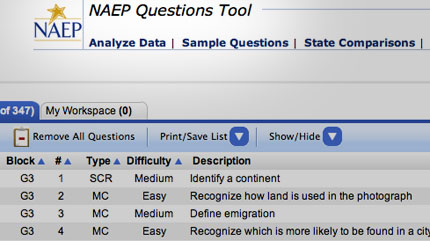
2010 ACTUAL QUESTION: Tropical forests are being destroyed at the rate of at least eleven million hectares each year, an area the size of Pennsylvania. About half of all tropical forests are already gone. Discuss two major reasons for this high rate of tropical deforestation.
OK, this is wrong on so many levels. Let's break it down:
"11 Million hectares destroyed"
No serious scientist today would validate this number. It dates back to a rough estimate made by a single Brazilian scientist looking at satellite photos of fires in the Amazon—in the 1980s! Yeah, it's a 30-year-old number based on sketchy information. Scientists today put the number at one-tenth that figure.
"...each year."
This implies there is a steady onslaught of rain forest destruction. Not so. There were some bad years in the 1980s, but things have changed radically since then. A report from last year showed a 90 percent drop in lost forest area.
"About half of all tropical forests are already gone"
Why is this sentence here? Seriously; it is absolutely unnecessary. The only reason to include this sentence is to make a political point.
"Tropical Forests"
This seems like an innocent phrase, but it's actually very tricky. Note how the test uses the term "tropical forest" not "tropical rain forest" That's because the test writers know full well that most deforestation in the Amazon is taking place in the chaco (dry forest) which is not an area of biodiversity. The wet tropical forests have a much slower rate of deforestation than chaco land.
"already gone"
Another subtle bias here: The word "already" is unnecessary, added to create a sense of urgency. In truth, deforestation has been going on in the Americas for hundreds of years.
Don't misunderstand—I'm not in favor of deforestation. But a standardized test isn't the place to push a point of view. And this wasn't the only question that had an obvious agenda. You can read through the questions on your own here.Tweet
One letter wrong

Forgotten secession: when the original 13 tried to split.

Italian guy creates his own nation

Sellari isn't the only mayor in Italy trying to save his city from annexation. Some towns on the bubble are inviting displaced Libyans to come and live. Others have pointed out that the cost savings of merging the small cities is actually less than the Italian Parliament spends on catering. It's not likely Fillettino will succeed, but politics in Italy has never been predictable. (You can read more here.)
Worst geography blunder in a movie?

The Rodney Dangerfield nation

Obama's secession secret?

OK, nobody actually believes that President Obama sides with Martha's Vinyard's lingering secessionists. So if secession came up, on say, a political talk show, I'd expect Obama's spokespeople to deny any silly secessionist talk. Wait a second! Obama's campaign advisor Robert Gibbs can't seem to stop talking about secession! And press secretary Jay Carney is no better. Yes, I know they are poking at Perry, but it strikes me as odd to point the "He's a secessionist" finger when their man is actually staying on Secession Island.
Criminal Corner - Another spot for the perfect crime?

It does, sort of. Remember, the reason criminals would go free in Loophole Land is because a jury could not be formed from residents of the required location (the Idaho portion of the park) because no one lives there. But the Montana portion of the park does have residents... about 40 of them. That said, a sharp lawyer could argue that 40 people isn't enough of a pool from which to draw a jury, but a judge could reasonably disagree.
But if your heart is set on committing the perfect crime in Montana's "Criminal Corner" you do have one other option—get your buddies to do the same thing. While 40 residents might be enough for one jury, it wouldn't be enough for 3 or 4 simultaneous trials. So if you and your friends commit multiple crimes... and draw straws... only the loser would likely face a trial. That's because—by the time the 3rd or 4th trial could be scheduled—too much time would have passed for the "speedy" trial required by law.
But again, don't try this at home. Crime is bad. Prof. Kalt agrees... he just wants the loophole closed.
Loophole land—where crimes can't be prosecuted. Really.

The problem begins with the boundaries of Yellowstone National Park. Yellowstone is mostly in Wyoming, but a sliver of the park extends into Idaho and Montana. When Congress created the U.S. District Court of Wyoming it included all of Yellowstone National Park. Big mistake.
Stay with me here.... so let's say you commit a murder in the portion of Idaho that's in the park (The red "Loophole Land" on my map). You'd be arrested and bound over for trial in the US District court in Cheyenne, Wyoming. But Article III of the Constitution states that the trial must be held in the state where the crime was committed—in this case Idaho. So you are sent to Idaho for trial. No problem there. But the Sixth Amendment also says that the jury must be drawn from the state and District where the crime was committed. The state is Idaho... but the District is the Wyoming District (which includes the sliver of Idaho that's in the park). So the jury would have to be drawn from residents who live in the portion of Idaho that lies in the park.
And that's where it gets interesting: nobody lives in that patch of Idaho. Nobody. No jury pool means no trial, means you go free.
This curious loophole was discovered by Prof. Brian C. Kalt, a respected legal scholar from Michigan State University. Georgetown Law Journal is reporting on the matter in an upcoming issue. (You can read Kalt's full article here)
Of course, committing crimes is bad. Don't do it. But if you're a screenwriter, this is great stuff! Maybe Dick Wolf will start a new series Law and Order: Idaho just to take advantage of this legal anomaly.
And if all this wasn't bizarre enough, Idaho's "Loophole Land" is just a few steps from another patch of American soil that also fell outside the law. Dubbed "Lost Dakota" it was a few acres of land that—erroneously—were not part of any state and thus, theoretically, outside the reach of law enforcement. (Much more on this in my book Lost States) Eventually that situation was fixed when Lost Dakota became a part of Montana. But Loophole Land remains an unsettling, well, loophole. If your nemesis suggests a camping trip near the Idaho/Wyoming border.... don't go!!!
When Hawaii was Russian

(There's a terrific article about the statehood struggle of Hawaii (and the possibility of a 51st state) in yesterday's Buffalo News—written by Alexander Heffner.)
The place that's name shall not be spoken

The Northwestern Confederacy
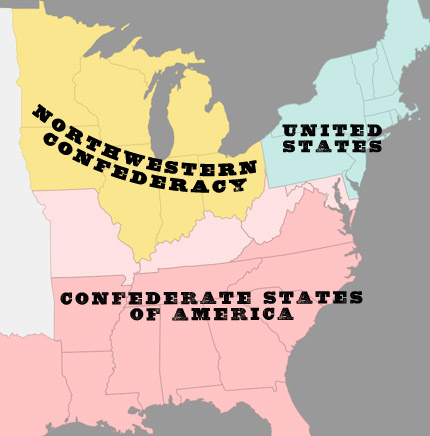
Above is a map of a little known secessionist chapter in American history, called the Northwestern Confederacy. Southerners hoped the northwestern states (which then was Ohio, Indiana, Michigan, Wisconsin, Minnesota, Illinois and Iowa) might also secede from the United States and form their own nation; or join with the south. There was actually a very practical reason for the northwestern states to do this. Many of their goods traveled down the Mississippi to market. Since the Confederacy controlled the southern half of the river, the Northwest needed good relations with the south in order to avoid economic hardship.
The idea was centered in Indiana, where even governor Thomas Hendricks said in 1862, "The first and highest interest of the Northwest is in the restoration and preservation of the Union but if the failure and folly and wickedness of the party in power render a Union impossible then the mighty Northwest must take care of herself and her own interests." So the idea of a Northwestern Confederacy had the support of many farmers—but they weren't alone. The northwest also had its share slavery proponents, and people who just wanted to end the war any way possible. Certainly, the creation of a Northwest Confederacy would have weakened the north and almost certainly ended the war.
Then again, the idea was considered treasonous.... which may be the main reason support didn't grow to any sort of tipping point.
Is Kansas flatter than a pancake?

Using a standard IHOP pancake, the team calculated a flatness of .957, which is flat, but shy of perfect flatness (which would be a 1.0). Applying the same formula to the topography of Kansas, the scientists came up with .9997, which is much much flatter than a pancake. So it's not really right to drive through Kansas and say, "This place is as flat as a pancake." However, if you ever went to IHOP and got a particularly flat pancake, you would be OK in saying, "This pancake is a flat as Kansas."
Thank university scientists by Mark Fonstad, William Pugatch, and Brandon Vogt, for solving this vexing question.
Subscribe to:
Posts (Atom)