Claire Suddath from Business Week weighs in on the current flurry of statehood proposals. (She interviewed me for about a half-hour or so a few days ago). The story does a nice job of putting the issue in some historical context, and connecting these movements to the recent polarization in politics. You can read the full story here.
by Michael Trinklein
Showing posts with label New states?. Show all posts
New York Times
The New York Times includes a quote from me on their story about the proposed state of West Colorado. Thanks Jack Healy. Read the story here.
Labels:
In the news,
New states?
4 new states from Maryland?
Just looking at map of Maryland makes it clear it's one of the most poorly-designed states—with ungainly tentacles spreading in all directions. The result has been a long list of proposals to carve out new states: Folks on the eastern side of Chesapeake bay have regularly clamored for separation. Washington DC (which is not actually part of Maryland, of course) also wants statehood. Now, western Maryland is getting into the act. “Western Maryland: A New State Initiative,” has been launched by a guy named Scott Strzelczyk. My map above overlays Strzelczyk's proposed state on top of the other statehood proposals in the region.
While the West Maryland idea has no practical chance to create the 51st state, there is a strategy that separatists like Strzelczyk might consider. I'll call it the "Middle County Swap"—and it would work like this:
Let's say you have two states that border each other, Blueland and Redland. Blueland tends to vote 51 percent for the Blue Party, and Redland votes 51 percent for the Red Party. Those margins are too close for the majority leaders in each state--who sweat out each election. Now, let's say the overwhelming majority of the voters in the Middle Counties vote for the Blue Party. They are sick of being governed by the Red Party so they petition to secede from Redland and join Blueland. This is actually good for Red Party leaders in Redland, because—despite becoming a slightly smaller state--they could now be assured of Red victories going forward. Because if the Middle Counties secede from Redland, then Redland has a higher percentage of Red voters. Blue Party leaders in Blueland get the same desirable outcome, that is, a higher percentage of Blue Party voters in their state. And Middle County voters get what they want; governance by the Blue Party. The only people who don't win in this scenario are the minority parties in each state who lose clout. They might not like it, but because they are minorities, they can be outvoted.
So if Scott Strzelczyk really wants to make changes to the governance in his region, he might look to join neighboring Pennsylvania, West Virginia, or Virginia. It's still a long, long, long shot... but it seems more feasible than creating a 51st state.
by Michael Trinklein
While the West Maryland idea has no practical chance to create the 51st state, there is a strategy that separatists like Strzelczyk might consider. I'll call it the "Middle County Swap"—and it would work like this:
Let's say you have two states that border each other, Blueland and Redland. Blueland tends to vote 51 percent for the Blue Party, and Redland votes 51 percent for the Red Party. Those margins are too close for the majority leaders in each state--who sweat out each election. Now, let's say the overwhelming majority of the voters in the Middle Counties vote for the Blue Party. They are sick of being governed by the Red Party so they petition to secede from Redland and join Blueland. This is actually good for Red Party leaders in Redland, because—despite becoming a slightly smaller state--they could now be assured of Red victories going forward. Because if the Middle Counties secede from Redland, then Redland has a higher percentage of Red voters. Blue Party leaders in Blueland get the same desirable outcome, that is, a higher percentage of Blue Party voters in their state. And Middle County voters get what they want; governance by the Blue Party. The only people who don't win in this scenario are the minority parties in each state who lose clout. They might not like it, but because they are minorities, they can be outvoted.
So if Scott Strzelczyk really wants to make changes to the governance in his region, he might look to join neighboring Pennsylvania, West Virginia, or Virginia. It's still a long, long, long shot... but it seems more feasible than creating a 51st state.
by Michael Trinklein
Labels:
In the news,
New states?
5 Tips for "North Colorado"
Time Magazine asked me to write a piece offering tips to proponents of the 51st state of "North Colorado." So here are my top 5 ideas...
Labels:
In the news,
New states?
"Time" quotes yours truly
I talked with Time magazine yesterday about the statehood plan brewing in northern Colorado. Nate Rawlings wrote a nice piece which includes a couple quotes from me and a mention of Lost States. Thanks Nate! You can read it here.
Labels:
In the news,
New states?
51st State in the High Plains
Now, if the movement truly wants to create a new state, they have some work to do. First, the counties of northeastern Colorado don't have nearly the population they'd need to start a new state. So I'd suggest they expand their reach and try and join with other statehood movements in the region. Western Kansas pushed for statehood in the 1990s; residents of eastern Wyoming and western South Dakota have long pressed for a state called Absaroka; and several movements have attempted to split off the Texas and Oklahoma panhandles to form the state of Texlahoma. Melding all these together creates a legitimate-sized state. I'd call it High Plains, but that's open for debate. Maybe "Lincoln" would be better.
I give credit to Weld County Commissioner Sean Conway who seems to understand that, practically speaking, states have to enter the Union in pairs (One leaning Democrat, one Republican). Puerto Rico wants statehood, and would be the perfect match for High Plains.
While High Plains would be among the reddest of red states, Democrats are realizing this might not be such a bad idea. New Republic magazine notes that removing red counties from Colorado would make the state more blue overall—important in that tipping-point state.
Labels:
In the news,
New states?
Chicago the 51st state?
The current movement doesn't seem to have all that much support, but the 20s version did... at least in Chicago. The city council actually voted in favor of beginning a secession movement.
So if the 1920s' Chicago rabble-rouser John B. Fergus could meet with the current separatist leader, Rep. Bill Mitchell of Decatur, the 51st state movement might have some legs.
News reports here and here.
Labels:
New states?
When Hawaii was Russian
Hawaii became a U.S. state 52 years ago yesterday. One long-forgotten chapter in Hawaii's history is when the Russians tried to take control of the islands. Back in the early 1800s, Hawaii was a coveted port for whalers. So, in 1816, the Russians began building a fort on Oahu, hoping to control the islands. King Kamehameha I would have none of it, and forced them off the island without any bloodshed. But the Russians didn't go home. Instead, they tried to build their fort on nearby Kauai. When Kamehameha found out, he took more severe action—deporting the Russians to California. This ended Russia's plans in Hawaii, opening the door for the United States a few decades later.
(There's a terrific article about the statehood struggle of Hawaii (and the possibility of a 51st state) in yesterday's Buffalo News—written by Alexander Heffner.)
Labels:
Fun map stuff,
New states?
West North Carolina... or Griffith
Are you ready for the new state of West North Carolina? Yesterday Ashville Citizen-Times columnist John Boyle officially launched the movement to make a new state from counties in western North Carolina. His reasons are the usual stuff—people in the faraway capital just don't seem to care about the hinterlands. Boyle waxed eloquently, "I say we yearn to be free, to shuck the yoke of oppression that Raleigh has kept clamped on our necks for two centuries." That's all fine and good, but here at Lost States, we say you don't have a movement until you have a map! So we took Boyle's description and made one (above). Boyle's next hurdle, (as regular readers know) is to come up with a catchy name. "West North Carolina" is a mouthful. He could take inspiration from the nearby State of Franklin proposal that almost succeeded 200+ years ago, just across the border from Asheville (in what is now Tennessee). Last time I checked, we still don't have a state named "Franklin," so that could work. Or if the new state really wants to get attention, they should honor the region's most-famous son: Andy Griffith. The 51st state of "Griffith"...now there's an idea that will get attention.
Labels:
New states?
51st state of "West Arizona" or ??
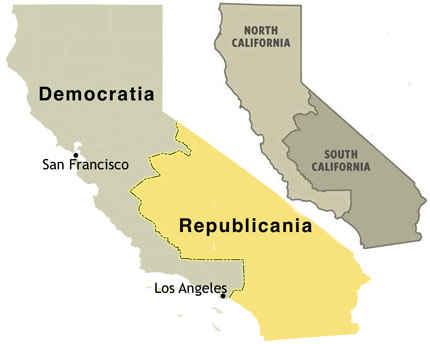
The attempt to split California to create the 51st state has big hurdle—the movement needs to come up with a better name. "South California" won't work, because, well, it not southern Cal. (If you don't have Los Angeles, you can't really be South California.) In an earlier post we suggested "Republicania,"and it seems we are not the only ones mulling this conundrum. Andrew Malcolm at the Los Angeles Times offered a number of choices recently, including New California, English Mexico, and Newer Mexico. Our personal preference was his suggested "West Arizona." After all, the people proposing the split have a lot in common with the prevailing politics in (East) Arizona. Let us know what you think the new state should be named!
Labels:
New states?
MIT study weighs in on the California split
MIT did a study which tries to identify natural geographic connections by looking at who we text and call. Quoting the MIT release, "in some cases, connectedness follows traditional demarcations such as state lines -- but in other cases, new patterns are emerging." There are all kinds of ramifications, and you can read the details here. The thing that struck me was the three-California split that the MIT study suggests makes sense. It's a lot different from Jeff Stone's recent proposal. And it's markedly different from Assemblyman Stan Statham's 3-state proposal in 1992. For example, Statham puts San Francisco in Central California, but MIT puts the city in the north.
The thing that's cool about the MIT study it that it's based on real people's daily lives. It shows who we are actually connected to, not who we say we are connected to. And it's amazing how many of these connections do follow state lines. California is the only state that the MIT study suggests needs to be split, in most other cases, the study suggests mergers. For example, the Carolinas are one cohesive unit, according to MIT. Fascinating stuff.
Labels:
In the news,
New states?
We get a nice mention in Huffington Post
The Huffington Post just ran a piece on the California secession plan... with several quotes from yours truly. A big thanks to Huffington Post writer Matt Sledge! Nicely done! Read it here....
Labels:
New states?,
Press coverage
"Supremely Ridiculous"? No so fast Jerry Brown
California Governor Jerry Brown's spokesman called the new plan to split California in two "a supremely ridiculous waste of everybody's time." No so fast, governor—you're missing the whole point. While it's true that the plan has an astronomically unlikely chance of succeeding, Governor Brown does not seem to grasp the other reason that Article IV, Section 3 of the US Constitution allows for states to be split: it lets people blow of steam. You know, that whole "redress of grievances" thing. In much of the world, people who are unhappy with government start shooting guns—here, we try to make a new state. It's fun, nobody gets hurt, and the would-be statemakers often get their grievances redressed.
And twice, the statemakers actually succeeded in the split—Maine split from Massachusetts, and West Virginia split from Virginia. Is Maine "supremely ridiculous"?
Labels:
New states?
California split approved by state legislature
It's true. The California state legislature approved splitting the state in two... back in 1859. The US Constitution Article IV Section 3 states that all it takes to split a state (and thus create a new state) is to get approval of the state legislature and the US Congress. Signoff by a state legislature has occurred three times in American history.
1) Massachusetts voted to set its northern district free to become Maine in 1820.
2) In the Civil War era, the "restored" Virginia government voted to create West Virginia. (There is considerable dispute about the legality of this vote, however).
3) California's legislature voted to split the state in two in 1859.
The first two votes resulted in new states, but California never got officially sliced. Why? The US Congress refused to ratify the plan, because they were worried that a new state would upset the tenuous balance between north and south. Of course, that "balance" was upset shortly thereafter anyway—when the Civil War broke out. Above is the split that the California legislature approved... hoping to create the new state of "Colorado." This week, California legislator Jeff Stone proposed a new split. But his goofy plan certainly doesn't have the support that the 1859 plan had. Hmmm. Maybe in some dusty back room in the US Capitol, the 1859 plan is still sitting there, waiting for Congress to finally give it the thumbs up.
1) Massachusetts voted to set its northern district free to become Maine in 1820.
2) In the Civil War era, the "restored" Virginia government voted to create West Virginia. (There is considerable dispute about the legality of this vote, however).
3) California's legislature voted to split the state in two in 1859.
The first two votes resulted in new states, but California never got officially sliced. Why? The US Congress refused to ratify the plan, because they were worried that a new state would upset the tenuous balance between north and south. Of course, that "balance" was upset shortly thereafter anyway—when the Civil War broke out. Above is the split that the California legislature approved... hoping to create the new state of "Colorado." This week, California legislator Jeff Stone proposed a new split. But his goofy plan certainly doesn't have the support that the 1859 plan had. Hmmm. Maybe in some dusty back room in the US Capitol, the 1859 plan is still sitting there, waiting for Congress to finally give it the thumbs up.
Labels:
In the news,
New states?
California split - a bad good idea
There's been talk in the last few days of splitting California to create the 51st state, but advocates have the names all wrong. (OK, the idea is lame too, but we'll get to that in a minute.) Jeff Stone, a Republican Riverside County supervisor proposes splitting California along the lines in the map above. He calls the new states "North California" and "South California." Seriously? He has Los Angeles in North California. He's also put cities that are further north than San Francisco (like Bridgeport) in South California. Huh? A much better name for these two states would be East California and West California. Or better yet, since Stone's real goal to to separate Republicans from Democrats, he might consider my naming suggestion in the bigger map above.
It's true that California should have split a long time ago... and it almost did in 1859 (Watch our video on this). But any proposal that puts Los Angeles and San Francisco in the same state... no one will take that seriously. More on the scheme here.
Labels:
In the news,
New states?
Surprising policy difference between Obama and Lincoln
Check out the remarkable thing President Obama said Tuesday about Puerto Rico. In his speech, he stated (regarding the island's future as a state or as an independent country), "When the people of Puerto Rico make a clear decision, my administration will stand by you." That might sound reasonable at first, but imagine Lincoln saying, "On the matter of whether to stay in the Union or leave, when the people of South Carolina make a clear decision, my administration will stand by you." Uh, no... Lincoln would never have said that. In fact we fought a war because Lincoln wasn't so big on local governments determining their status on their own.
Don't misunderstand—I'm not saying Obama is right or wrong. Heck, I'm not even saying Lincoln was right or wrong. My only point is that these guys are diametrically opposed on the notion of self-determination.
Labels:
In the news,
New states?
Puerto Rico: more like Hawaii? Or Philippines?
There are two ways to handle Puerto Rico. The Hawaiian way or the Philippines way. Both Hawaii and the Philippines (like Puerto Rico) are islands acquired by the US in the 1890s. All three have populations that are ethnically and culturally distinct from the mainland US. All three faced (or face) this question: statehood or independence? In the case of the Philippines, the US considered statehood, but opted to give the islands their independence. In the case of Hawaii, the US considered independence, but opted for statehood. But Puerto Rico is stuck in limbo. The U.S. is like the boyfriend who refuses to get married... and Puerto Rico is the girlfriend who deserves a commitment... or be set free.
Labels:
New states?
Why Republicans should support Puerto Rican statehood
![]() |
| Pres. Obama with 51-star flag favored by many Puerto Ricans |
The point here is that the state of Puerto Rico isn't necessarily going to vote Democratic. Many Latinos are conservative on social issues, and thus vote Republican. The current governor of the island, Luis Fortuño, is a Republican.
One crafty GOP strategy would be to advocate statehood (and grab Latino votes nationwide) by evoking the Lincoln-esque notion that the US should not have any second-class citizens. The talking points would go like this: Puerto Ricans fight in American wars, but they cannot vote for the commander-in-chief. While Luis Fortuño could run for President of the United States, he cannot, by law, vote for himself. This is the kind of injustice Republicans fought and died for 150 years ago. Alas, today, they seem quite happy to ignore the plight of second-class citizens in Puerto Rico—and prefer to let Democrats take the high road on this issue. Regardless of which party carries the ball, the goal should be statehood OR independence. The middle ground—of second-class citizenship—isn't the American way.
Labels:
In the news,
New states?
Puerto Rico - 11 days to statehood?
Just 11 days from now, Puerto Rico will get its first presidential visit in 50 years—reigniting the question of whether the island should become the 51st state. Here's why this needs to be resolved: America shouldn't have any second-class citizens. If you're an American, you should have the same rights as everyone else. Puerto Ricans don't. That doesn't necessarily mean Puerto Rico should become a state. Rather it means they should be either in or out. That's always been the deal in America.
Territories were never supposed to be a long-term arrangement. When the Philippines were in the same situation, statehood was considered, but independence was the will of the people. All good. Puerto Rico should do the same: Full statehood, or independence. (And can someone please explain to me why Puerto Rico gets to enter the Miss Universe pageant alongside Miss USA? Do the pageant people not understand that Puerto Rico is part of the United States? Wait, Donald Trump owns that pageant. Now I get it.) Check out the zoomable 1952 map of Puerto Rico above
Labels:
In the news,
New states?
Baja Arizona map
Reports on the proposed 51st state of Baja Arizona are heating up, but no one seems to have a clear, simple map of this idea. So I made one. There is a larger version at flickr that you're free to use in your blog, newspaper etc. Wire service Reuters has a mapless story today—as does The Atlantic. How can they have a story about a new state--and not have a map?! Sigh.
Labels:
In the news,
New states?
Subscribe to:
Posts (Atom)