New book by Michael Trinklein

Check out the new book from Michael Trinklein, the author of Lost States. Titled Fun Maps: A quirky collection of geographic curiosities, it's an eclectic collection of grin-inducing maps—priced at just $3.99.
Richly illustrated, this book offers an entertaining stream of delightful maps and fascinating facts. Discover the city that wants to switch states, the patch of Idaho where crimes can’t be prosecuted, and the Civil War plan for the north to secede. 
Learn about the U.S. Congressman who made the most incredible geographic blunder of all time, the U.S. coin that botched the map of Georgia, and a list of movies that get their geography all wrong. Find the place where 5 states meet (almost), and learn the most-likely location of Atlantis. Best of all, Fun Maps has dozens of original maps, all optimized for viewing on your Kindle.
Many of these tidbits have been written about in this blog; Fun Maps brings it all together in one entertaining package.

Canada - U.S. merger

Should Canada and the United States merge? What once might have seemed like a crackpot idea is given a very serious look in Diane Francis' new book Merger of the Century: Why Canada and America Should Become One Country.  Her premise is that Canada needs the United States' protection—and capital. And the United States needs Canada's untapped natural resources and strategic land mass. It's a perfect match according to Francis. Of course, this isn't a new idea. Had a few battles in the War of 1812 gone differently, the amalgamation of the two countries might have happened 200 years ago. And whenever Quebec threatens secession (as it did seriously in the 1980s and again in the 90s), there is talk about which of the other provinces might join the U.S. What's new is Francis careful weighing of the economic and political issues as they stand today. The Wall Street Journal found the idea interesting, and devoted two-thirds of a page to Francis' ideas. But the Journal had no map! So I created one (above.)

How the British see the states


Buzzfeed asked a bunch of British people to fill in a map of the states, and many did surprisingly well—better than the average American. Some of their state names were wrong, but better than the actual names. For example, one person filled in the Nebraska space with "Middleshire." Nice. And what elementary school kid wouldn't agree that a better name for Colorado is "Squaresies." My personal favorite was the person who (working from north to south) added North Dakota, South Dakota, and Further South Dakota (above). See all the maps here.

Denver Post fact-check

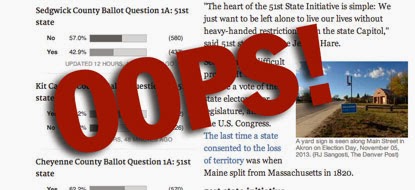
I take no pleasure in correcting the Denver Post, or their source Prof. Richard Collins, a constitutional law expert at the University of Colorado—but, well, they got it wrong yesterday. In the Post's article on state secession efforts in Colorado, writer Monte Whaley wrote, "The last time a state consented to the loss of territory was when Maine split from Massachusetts in 1820." That's not accurate. First, West Virginia split from Virginia in 1863. Thus the Virginia legislature did consent to the loss of territory. However, many would argue that the Virginia legislature that signed off wasn't the "real" legislature, it was a dummy group that was quickly formed by northern politicians when the "true" Virginia seceded from the United States.

So I can forgive Prof. Collins that oversight, but not the split of California in 1859. Southern "Californios" were so concerned about the massive influx of gold rush miners in the north, they pitched the idea of splitting California. And in 1859 the California legislature DID consent to split the state in two. The U.S. Congress did not act, but the state did, an important landmark that is often forgotten.

And if we want to get technical, there have been dozens of times that states have consented to give up small bits of territory. For example, in 1977 Texas gave away land to Mexico near the city of Rio Rico. So hopefully the Denver Post will issue a correction, and Prof Collins will pick up a copy of  Lost States ;)

by Michael Trinklein


Raise a Stink

Jake Grovum at Stateline talked with me last week... and wrote a nice piece focusing on the side of the 51st state issue that is all too often forgotten. That is, the goal in places like Colorado isn't really to get a new state, it's to get the government pay attention. From that perspective, the Colorado movement has been a big success. Read more here.


by Michael Trinklein

61 State map


The New Republic envisions all the statehood movements getting approved... and creates a map to reflect the new reality. While none of the statehood movements on their map stand much of a chance, it does help to visualize the red/blue divide even more precisely than the usual presidential election maps. While I appreciate writer Nate Cohn taking on this issue, he oddly neglects the one statehood movement that actually has a chance: Puerto Rico.  Read the article here.

by Michael Trinklein

Business Week weighs in

Claire Suddath from Business Week weighs in on the current flurry of statehood proposals. (She interviewed me for about a half-hour or so a few days ago). The story does a nice job of putting the issue in some historical context, and connecting these movements to the recent polarization in politics. You can read the full story here. 


by Michael Trinklein

New York Times

The New York Times includes a quote from me on their story about the proposed state of West Colorado. Thanks Jack Healy. Read the story here.

4 new states from Maryland?

Just looking at map of Maryland makes it clear it's one of the most poorly-designed states—with ungainly tentacles spreading in all directions. The result has been a long list of proposals to carve out new states: Folks on the eastern side of Chesapeake bay have regularly clamored for separation. Washington DC (which is not actually part of Maryland, of course) also wants statehood. Now, western Maryland is getting into the act. “Western Maryland: A New State Initiative,” has been launched by a guy named Scott Strzelczyk. My map above overlays Strzelczyk's proposed state on top of the other statehood proposals in the region. 

While the West Maryland idea has no practical chance to create the 51st state, there is a strategy that separatists like Strzelczyk might consider. I'll call it the "Middle County Swap"—and it would work like this:

Let's say you have two states that border each other, Blueland and Redland. Blueland tends to vote 51 percent for the Blue Party, and Redland votes 51 percent for the Red Party. Those margins are too close for the majority leaders in each state--who sweat out each election. Now, let's say the overwhelming majority of the voters in the Middle Counties vote for the Blue Party. They are sick of being governed by the Red Party so they petition to secede from Redland and join Blueland. This is actually good for Red Party leaders in Redland, because—despite becoming a slightly smaller state--they could now be assured of Red victories going forward. Because if the Middle Counties secede from Redland, then Redland has a higher percentage of Red voters. Blue Party leaders in Blueland get the same desirable outcome, that is, a higher percentage of Blue Party voters in their state.  And Middle County voters get what they want; governance by the Blue Party. The only people who don't win in this scenario are the minority parties in each state who lose clout. They might not like it, but because they are minorities, they can be outvoted. 

So if Scott Strzelczyk really wants to make changes to the governance in his region, he might look to join neighboring Pennsylvania, West Virginia, or Virginia. It's still a long, long, long shot... but it seems more feasible than creating a 51st state. 


by Michael Trinklein


5 Tips for "North Colorado"

Time Magazine asked me to write a piece offering tips to proponents of the 51st state of "North Colorado." So here are my top 5 ideas...

"Time" quotes yours truly

I talked with Time magazine yesterday about the statehood plan brewing in northern Colorado. Nate Rawlings wrote a nice piece which includes a couple quotes from me and a mention of Lost States. Thanks Nate! You can read it here.

51st State in the High Plains

A number of counties in northeastern Colorado are talking about creating a new state—and it's more than just talk, as ballot measures and votes are happening in several counties. Does this movement have any hope? The answer may surprise you. First, if the question is, "Will the movement get results for its backers?" then the answer is almost certainly "yes." Every time a movement like this gets going, it stems from some perceived inequity. Typically people in outlying areas feel like the central government isn't responsive. So they threaten secession, which attracts enough attention to get some concessions from officials in the more populated areas. In the case of Colorado, the end result of this might be some compromise on fracking laws which have been divisive. 

Now, if the movement truly wants to create a new state, they have some work to do. First, the counties of northeastern Colorado don't have nearly the population they'd need to start a new state. So I'd suggest they expand their reach and try and join with other statehood movements in the region. Western Kansas pushed for statehood in the 1990s; residents of eastern Wyoming and western South Dakota have long pressed for a state called Absaroka; and several movements have attempted to split off the Texas and Oklahoma panhandles to form the state of Texlahoma. Melding all these together creates a legitimate-sized state. I'd call it High Plains, but that's open for debate. Maybe "Lincoln" would be better.  

I give credit to Weld County Commissioner Sean Conway who seems to understand that, practically speaking, states have to enter the Union in pairs (One leaning Democrat, one Republican). Puerto Rico wants statehood, and would be the perfect match for High Plains.

While High Plains would be among the reddest of red states, Democrats are realizing this might not be such a bad idea. New Republic magazine notes that removing red counties from Colorado would make the state more blue overall—important in that tipping-point state. 

Puerto Rico Votes for statehood.

The 51st state just got closer to reality than any time in the last 100 years. In yesterday's election, Puerto Ricans voted--for the first time--to embrace statehood. Both Republicans and Democrats have voted to follow the will of the people on this one... so stay tuned. And buy stock in a flag company! Read more here.

Chicago the 51st state?

Two rural Illinois legislators want to expel Chicago from Illinois. Their idea is to force Chicago to become the 51st state, so the rest of Illinois won't be dominated by the Windy City. News reports, however, miss the irony of all this—it used to be the other way around. That is, back in the 1920s, Chicagoans were the ones who wanted to form a new state, because they felt dominated by "downstate" legislators.

The current movement doesn't seem to have all that much support, but the 20s version did... at least in Chicago. The city council actually voted in favor of beginning a secession movement.

So if the 1920s' Chicago rabble-rouser John B. Fergus could meet with the current separatist leader, Rep. Bill Mitchell of Decatur, the 51st state movement might have some legs.

News reports here and here.

The town in two states

The fine folks of Price Place, Arkansas seem to live in two states simultaneously. They pay taxes to Arkansas, but their kids go to Missouri schools. Their Arkansas drivers licenses say they live in Missouri. It's really weird. And now it's about to change. These Arkansas residents will actually get Arkansas addresses... and they are really mad about it. Yeah, I don't get it either, but one thing is clear: this is one state border that should be re-routed. You can get the full story here.

All 50 states mentioned in movies

I'm not sure how anyone could have enough free time to create this, but I'm glad they did. If you are studying state capitals in school, or just curious, here are all 50... through snippets in movies.

Hiatus

Real life is ramping up—so I'm going to have less time for this blog in the coming months. It's a bit of a bummer, because creating a new map every day has been a lot of fun. But, alas, my family needs me to do stuff that actually pays the bills. I'll try to post occasionally... but the daily geographic curiosity... well, that's going on hiatus. MIKE

Weekly World News - flag "fail"

I put "fail" in quotes, because, of course, everything in Weekly World News is a silly joke. After all, this is the paper that once defended itself in a libel case by telling the judge that no one actually believes anything they write. So I wasn't all that surprised by an article that claims Mexico will be the 51st state. It's all in good fun. But what was surprising was the flag they used to illustrate the story (above). It has 140 stars! I could understand a 51-star flag, or maybe a flag with 81 stars.... adding in the 31 states of Mexico. But a 140 star flag? Does no one at the paper know how many states we have? Or did they think their audience is stupid enough to think that 50 + 1 = 140. Oh.

Young state riddle

Just four US states are less than 100 years old. Can you name them? Two are so easy, I included them on the map above: Alaska and Hawaii. But can you name the other two youngsters? The answer is here. 

County named after killer

So an outsider comes to town and shoots one of the locals dead in cold blood. The shooter is then hailed as a hero, and the townfolk decide to name a county after the killer. This is the true story of Louisa County, Iowa.

In the 1830s, William Smith wanted a mining claim owned by the Massey family. So Smith and his son shot and killed Woodbury Massey... and then rode through town proclaiming that they'd kill any other Masseys they could find. At this point, Woodbury Massey's brother, Henry, took preemptive action and killed William Smith. Then the story gets interesting. 16-year-old Louisa Massey, sister of Woodbury and Henry, arrives in town and cooly proclaims she's just doing some shopping. But when she spots the younger Smith in the store, she pulls out a gun and shoots him dead too.

Louisa became an instant hero. Newspaper reports wrote: "The upper river county went wild with her praise. No war hero was ever welcomed with greater enthusiasm... cheering throngs greeted her at every stop." What is the moral of this story? I have no idea. Certainly, no one today wants 16-year-old girls involved in revenge killings. It might be one thing to exonerate Louisa, but to make her a hero, and name a county after her? It all seems very strange. You might explain it by saying that times were different then; but after Lincoln was shot, nobody was clamoring to create John Wilkes Booth county. About the only explanation I can come up with: the Smiths must have been some really mean and nasty dudes.

You can read contemporaneous news reports about Louisa Massey here. And a book here. (Another great story for a screenwriter. But who to play Louisa? Hailee Steinfeld? Dakota Fanning? Selena Gomez?)